Welcome back, dear reader. This blog entry is the final part of a blog series. You can find the first part here and the second part here. Today, I shall conclude the story.
Our demo launch on itch.io had been very underwhelming. We had gotten a handful of downloads and some feedback but the game was still pretty unknown to the larger public. The reasons for this were pretty obvious: Our game was not that interesting. The graphics were not amazing. The core gameplay was not great. Sure, it had a lot of elements that could be interesting for a lot of players but they were not there yet. Making this game worth playing would take a lot of work.
Luckily a few things happened that helped set us on the right path. First, we received some very constructive feedback about our gameplay and the graphics. It was pointed out to us that some sprites did not stand out too much from the environment and that certain parts of the world looked rather flat. Players also said that the controls and the UI were very confusing. We also did not have a tutorial and our interfaces were not intuitive enough for everyone to understand what our game was really about. We took notes of the things we felt were most critical to the overall gameplay experience and made a plan to start fixing things.
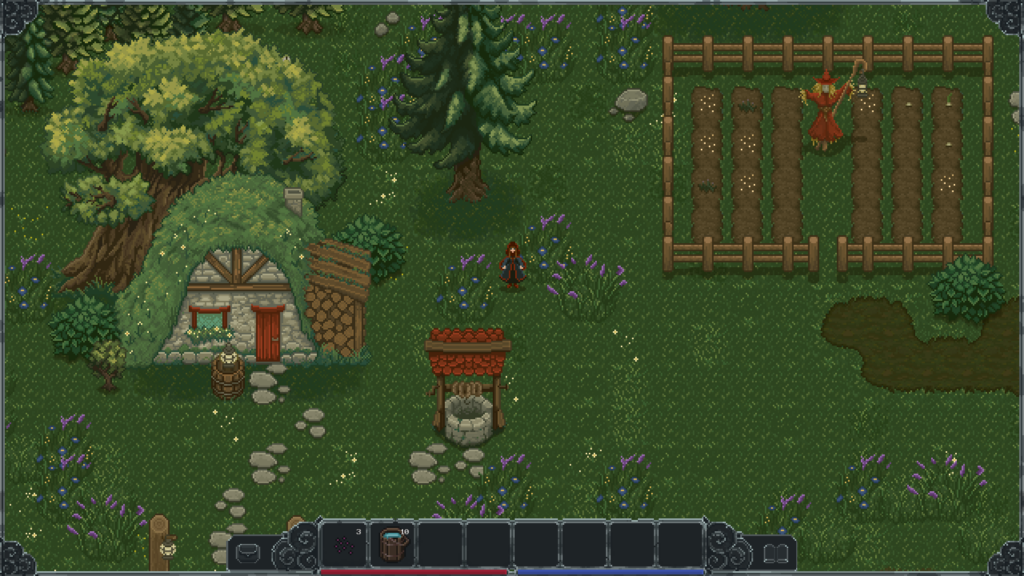
What the home area looked like in our first demo.
The second thing that happened was that a streamer downloaded our demo and featured it in a stream. This took us completely off guard. I have not personally watched too many Let’s Play -videos or gaming streams. I do understand the appeal but I simply don’t have the time to really get into it. Maybe because of my own limited exposure to streaming culture, I never would have considered our game to be suitable for streaming. Our game does not have a lot of the kind of action that I imagine would make for a very entertaining video. But apparently, there are streamers willing to play games like ours.
Watching a stranger play your game can be absolutely nerve-wracking. They do not know you, so they have no reason to be nice. But this makes it a wonderful learning opportunity for a game developer. A streamer’s reaction to the game will be genuine and unfiltered. If there are things that are somehow ”off” about your game, a streamer will spot them. So we watched the stream with cold and sweaty palms, we laughed, we cried, we smacked ourselves on the head a few times for being very bad game designers. And we took a lot of notes.
The third important thing was the fact that I still needed to finish my degree. In order to do that, I needed to write a thesis. I was not too excited about that. I think academic research is important and all but I much prefer telling stories to citing sources. But I came up with a brilliant plan – I would write my thesis on game marketing! That way I could learn real-life skills which would benefit our game project and I would also get school credits. Obviously writing the thesis would take away some precious time from game development but it would pay off in the end. I was going to learn how to, as the cool kids say, ”moneymaxx” our game. At the time I was pretty convinced that there would be some ”one weird marketing trick the doctor’s hate” somewhere out there. When I would find that one weird trick, marketing would be a breeze!
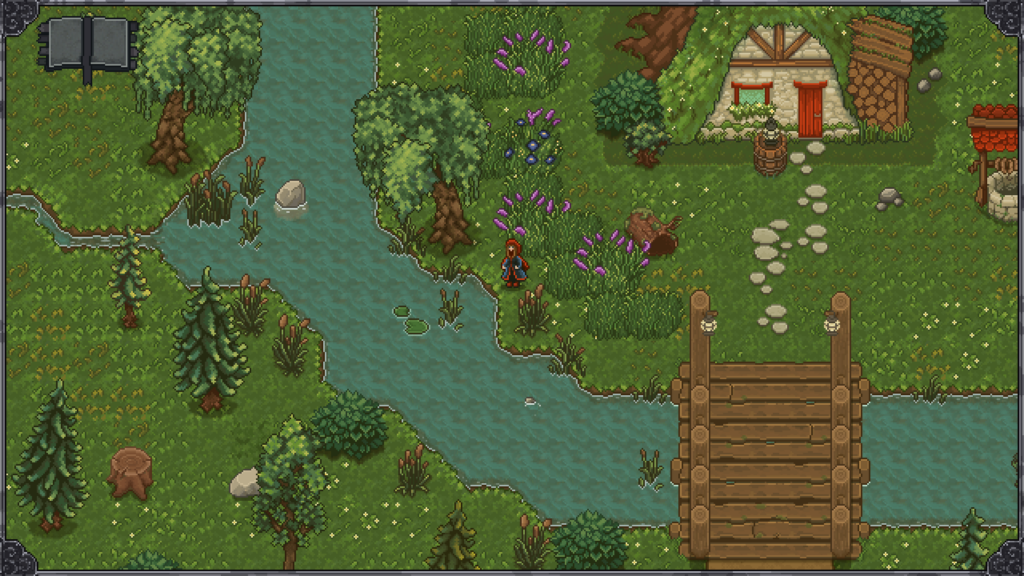
What our home area looks like now.
Improving the user experience
We had made a few really silly mistakes that really hurt the user experience. This was mostly due to good intentions and plans that were not properly executed. Originally I had a wish that the player could move around using only the mouse. My desire for this was primarily selfish: I prefer games that you can play with a mouse only. Why? Because I like to combine gaming with a nice beverage, such as coffee. I call this ”chillmaxxing” because I like to pretend I am still hip and cool.
It was not until much later that I read about a famous exchange a certain developer had with a disabled player and began to see accessibility as something worth thinking about in game development. There might be other people out there who prefer to play games with just a mouse. Not because they necessarily want to, but because they have to. And it would be amazing if my desire to ”chillmaxx” could lead to our game becoming more accessible for everyone.
However, our goal of making the game playable with only the mouse was not realized in our first demo. We had optional mouse movement for the player but it did not work too well. The player had to hold down the mouse button to keep moving, which would be very straining on the hand and wrist.
And nothing in our UI was really designed to work with mouse-only functionality in mind. You could open up things in the UI with the mouse and you could not close them and things could not be added to the action bar without the use of the keyboard.
We changed all of that. It is not yet perfect, but now it is possible to play the game with just your mouse. We also completely redesigned our potion brewing. It used to be completely reliant on the use of a keyboard and had a rather confusing UI. Now you can drag the ingredients into the cauldron and actually stir the liquid with a ladle, which has become one of my favourite things ever.
There are still some things that could be improved and a plethora of other issues that we need to solve. But at this point, I think we have made something solid that we can build on.
Fixing the game’s art
It seemed like the biggest problem with our art was the lack of contrast and dark, unsaturated colours. So I gathered every graphical asset into one big file and started adjusting the colours. I cranked up the brightness and saturation and adjusted the colour balance to get rid of this weird blueish tint by adding more yellow. I also started to add a darker outline to everything to make things stand out more. This included the character sprites and objects like trees, rocks and everything that was supposed to stick out of the flat surfaces.
A lot of the graphic tiles could be fixed with simple colour adjustments but some things needed a bit more tweaking. I did not like the majority of our trees and buildings so I completely redrew those. Previously I had made the mistake of working with the game’s assets in isolation. As a result, a lot of our assets did not look like they belonged in the same place. So I developed a process where I would draw and edit assets in tandem with level design. Changing my workflow made asset creation a lot more easy and efficient and it helped me to keep the art style more cohesive.
One of the most notable changes we made in the game was the combat screen. The original version had the main character standing in front of the enemy, in a style that was inspired by games like Quest for Glory and Pokemon. I always felt that the combat screen’s art style clashed with the rest of the game. It would also take a lot of time to make different attack animations for the main character – each new type of weapon would need a new animation. I wanted to come up with a solution that would cut down our work load, at least a little bit.
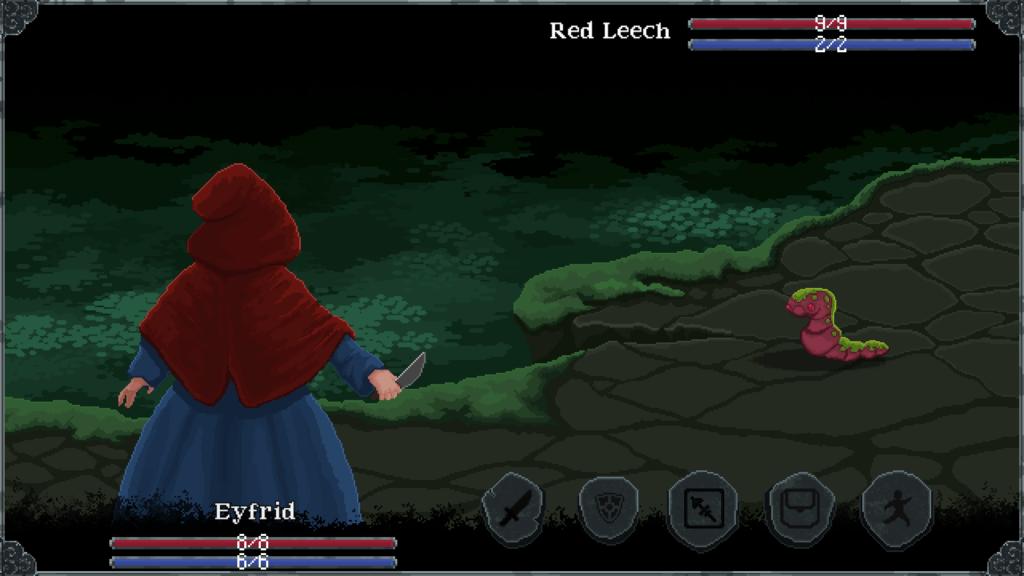
Our old combat screen.
Eventually, my partner came up with the idea of having the enemies represented as playing cards. The cards could be stacked in rows and on top of one another, meaning that there could be more than one opponent facing the player at once. The cards and the rest of the battle UI would simply float on top of the game world. The player character would not be seen at all – only their attacks and spells would show up on the screen. This meant the only thing we would have to animate was the enemies and the spell effects. We both ended up really liking the new combat UI and I think updating the style was the right choice for our game.
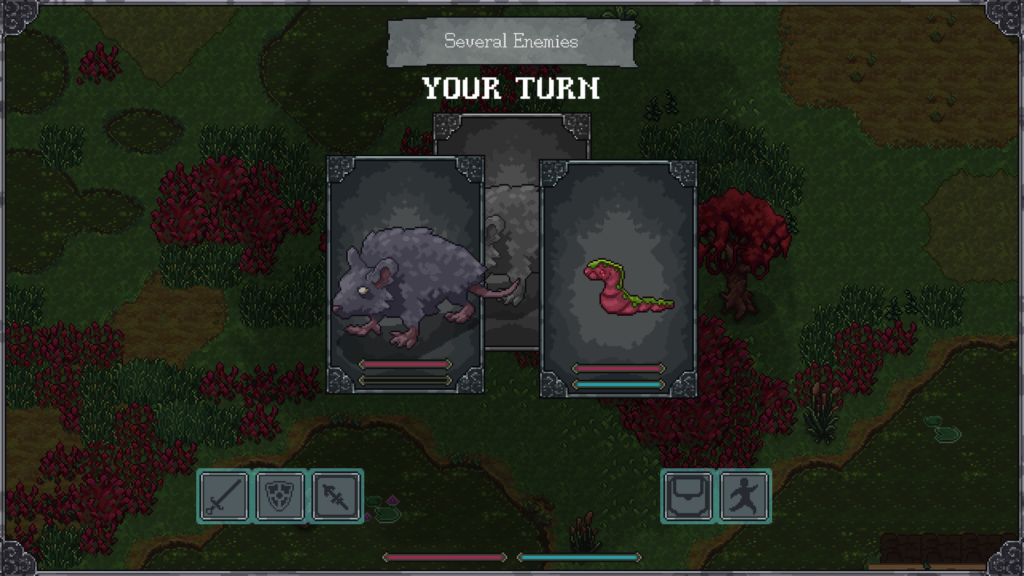
Our new combat screen.
Marketing our game
Eventually, I had to learn the sad truth: there is no one weird trick to marketing an indie game*. It is an extremely challenging process – one that should not be separated from the act of game creation itself. I plan to write a more detailed account about this topic in the future. While I am not a marketing expert, I have made some observations that I believe could be interesting to other indie game developers and content creators in general.
When it comes to game marketing, there is still a lot more we could be doing. But for now, we keep the marketing stuff at a low simmer rather than an intense burn. On average, I spend around 1-2 hours each week to making and sharing content about our game. My goal is to keep the time spent on different social media platforms as minimal as possible. While I think that social media has the potential to change some things for the better, I also believe that it can be deeply harmful to one’s mental health if consumed in excess.
That is not to say that I don’t find certain aspects of social media absolutely delightful. I like following people who create things and share their own stories and struggles. I think the game development community is full of wonderful, creative people who can, at best, support and inspire each other. But sometimes instead of inspiration, you will start to compare your own work to that of someone else. You can become filled with envy. And while sometimes envy can propel you to improve, it can also cripple your creativity.
Social media also is not very effective in terms of raw wishlist numbers or click-through rates. The amount of traffic being directed to our Steam page from different social media platforms is extremely low. What has worked most in our favour has been Steam’s recommendation algorithm and an online festival where our game was showcased. So our marketing strategy for the future will be to improve our game to the best of our ability so that we’ll be accepted into more online festivals, make our game more appealing to streamers and content creators and update our marketing assets when we have a bit more polished content to show. And while I don’t believe in gimmicks or ”one weird marketing trick” to end all marketing tricks, I will still post stuff on social media and see what sticks. Not only because I think it would be fun to discover something that actually works in the age of ever-worsening social media, but it would be so cool to be featured on a certain, highly esteemed game marketing blog under the headline: ”Here’s one CRAZY TRICK one developer did to gain THOUSANDS of wishlists”. One can always dream.
* I actually did discover the secret to successful marketing during my internship. The secret is MONEY! Not exactly what I was hoping to discover… I had hoped it could be something like “be yourself” or “always treat everyone with kindness”. If only we lived in a world where kindness and honesty were enough.
What is to come
We are trying to be realistic with our dreams. It is extremely difficult for an indie studio to be successful with their first game. I think being able to finish this game would be a huge accomplishment in itself. Of course, I am still observing the numbers and learning about the best ways to promote our game, but I am trying not to obsess over it. I want to be fully focused on making the best game that we can with the skills that we have.
My most important goal is for the players to enjoy the game’s story and to be able to care about the characters. I would like them to feel at home in the village of Vilgesby. And I hope that the final mechanics, such as the skill progression, the combat, agriculture and potion brewing will not clash with the story. I also want the game to support different play styles. If someone does not like combat, they can avoid it. If the player does not care for the grand plot to save the world and would rather play a cozy farming simulator, they can do that. And if they want to succumb to their inner darkness and make the whole world burn, they can absolutely do that too.
I would also like our game to be more accessible to different players. The perfect game in my opinion would be one that anyone could pick up and play, no matter their skill or previous experience in gaming. Of course, my idea of a perfect game is slightly at odds with my partner’s idea of a perfect game. He’s more of a ”hardcore gamer” than I am and does not like the idea of us handholding the player all the time. And it’s not like I want to make an entirely ”casual” game – I like challenges, mysteries and the joy of discovery as much as he does. But I think there is a space between ”casual” and ”hardcore” that we should aim for. It is my hope to achieve this balance but we will have to see what we can cook up.
Currently, we are at a stage where we are adding more content to our game world and improving the things that we already have. Most of our game’s maps are already fleshed out. All of the most vital game mechanics are in place but they need a bit of balancing. We’re making the world feel more alive with character animations and by telling the little people what to do with their day. On different days the wealthy estate owner will be soaking in his bathtub, the village priest will be holding a mass and the peasants will be tilling their fields. Sometimes a group of travelling performers will be camped by the forest road. Obviously, we’ll also have more of the kind of content that makes the backbone of RPG games: more things to craft, enemies to defeat, spells to learn, and secrets to discover. And there will be characters you can either kiss or kill, depending on your preference.
There is still much to be done but we will update you with more details in the following months. I hope this little blog series has sated your curiosity about us as a team and the game we are developing. If I have raised more questions than I have answered, I apologise. At this stage of development, we still have to be a little bit vague and cryptic about certain things. I do not want to make promises that we can’t deliver. But I hope that soon we will be able to show a more complete picture of what the finished game will be like.
Until then, thank you for reading this blog series and have a fantastic day!
– Erkenmormel